
Cost of Vacuum Cleaner: What Drives the Price and How to Choose
Most people start shopping for a vacuum with a price in mind, then find machines that seem identical selling for wildly different amounts. One upright costs $80, another costs $600, and the product pages read almost the same. Without a clear sense of what separates them, it is easy to overpay for features you will not use or underspend on a machine that fails within a year.
This guide breaks down what actually drives the cost of a vacuum cleaner. You will learn which factors move the price, what to expect at each budget level, how much different types typically cost, and the ongoing expenses that many buyers miss. By the end, you should be able to match a realistic budget to your actual cleaning needs and recognize when spending more is worth it.
What Actually Drives the Price of a Vacuum Cleaner
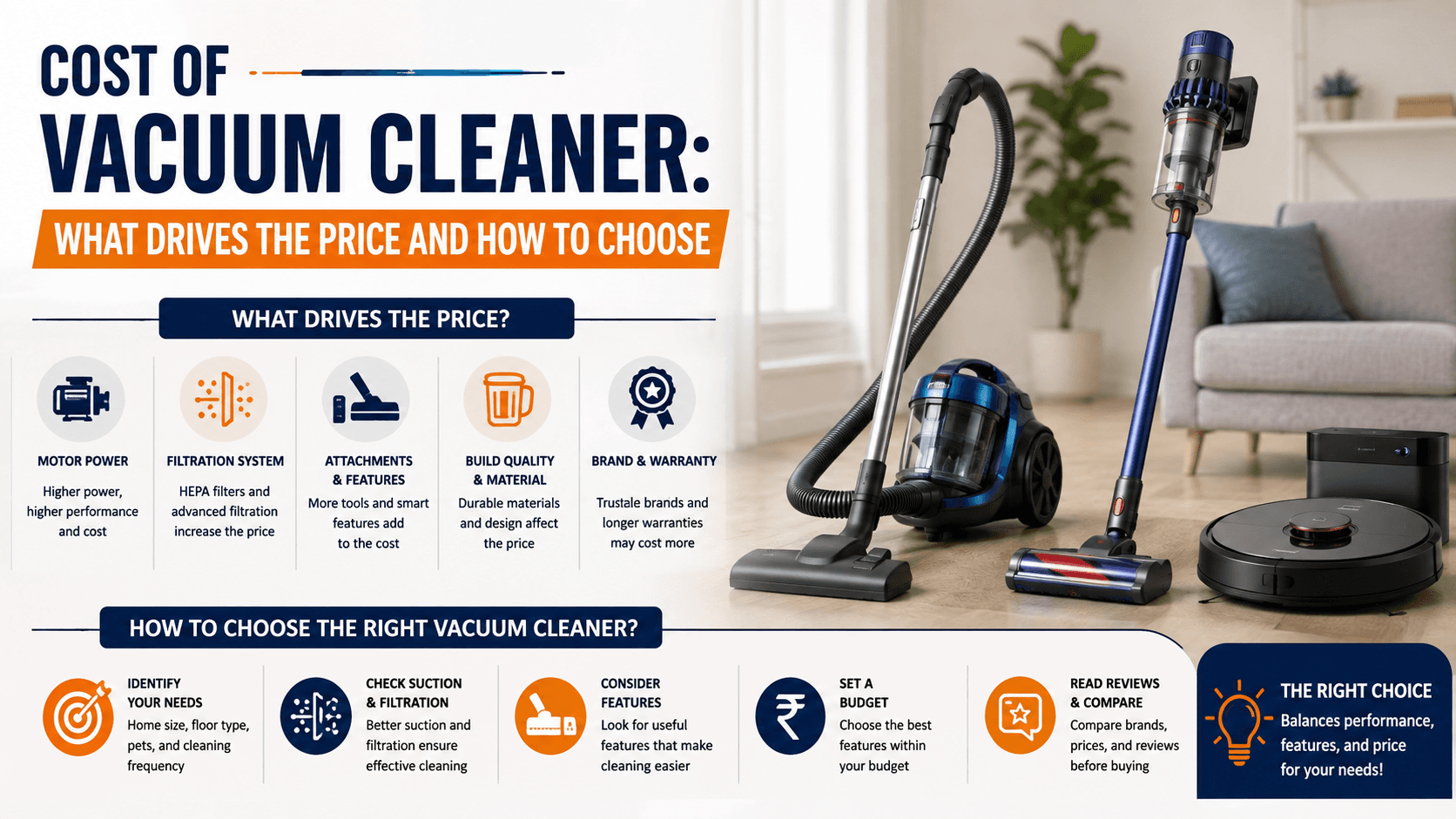
A vacuum's price reflects a set of concrete factors, not marketing alone. Understanding them helps you judge whether a higher price buys real value or just a bigger name.
Type and Design
The category of vacuum is the single largest factor in its cost. A basic handheld and a self-emptying robot vacuum serve different needs and sit at opposite ends of the price range. Before comparing individual models, decide which type fits your home, because that choice sets the range you are shopping within.
Suction Power and Motor Quality
Stronger, more efficient motors cost more to build. A higher-end motor can maintain suction longer and often runs more quietly, but raw power is not always the deciding factor. Match the suction to your floors, since deep carpet demands more than hard floors do, and paying for extreme power you never use adds cost without benefit.
Filtration System
Filtration affects both price and the air you breathe while cleaning. Basic foam or cloth filters cost little, while sealed HEPA systems that trap fine particles add to the price.
Standard filters handle everyday dust and are the least expensive.
HEPA filters capture much smaller particles and can help if anyone in your home has allergies or asthma.
Sealed systems keep captured dust from leaking back into the air, and they command a premium.
If dust sensitivity is a concern, better filtration may justify the added cost. If not, a standard system often does the job.
Brand and Build Quality
Established brands often charge more, and part of that price reflects better materials, longer warranties, and easier access to replacement parts. Part of it reflects the brand name alone. A well-built machine can last many years longer than a cheap one, so a higher upfront price sometimes lowers the cost per year of use. Weigh reputation against the specific build, not the logo by itself.
Features and Extras
Extra capabilities each add to the price. Some earn their keep, and some do not, depending on how you clean.
Bagless designs and easy-empty bins
Cordless operation and swappable batteries
Smart controls, app connectivity, and mapping
Self-emptying docks for robot models
Specialized attachments for pets, corners, or upholstery
A useful rule is to pay for features you will use weekly, not features that sound impressive in a demonstration.
Price Ranges by Category
Vacuum prices sort roughly into three tiers. These ranges are general guides, and prices shift with sales and region, but they give you a realistic frame.
Budget: $50 to $150
Budget vacuums cover the essentials. You get functional suction, basic filtration, and a limited set of attachments. Build quality is lighter, and motors are less efficient, so these machines suit smaller homes, light use, or a tight budget.
The honest tradeoff is lifespan. A budget machine may serve you well for a few years, but it is more likely to need replacement sooner than a sturdier model. If your cleaning needs are modest, that tradeoff can still make sense.
Mid-Range: $150 to $400
This tier is where most buyers find the best balance. Mid-range vacuums typically offer stronger suction, better filtration, more durable parts, and a fuller set of attachments. Many cordless and robot models start here as well.
For an average household with a mix of carpet and hard floors, a mid-range machine usually delivers the most value over its life. You pay more upfront, but the improved build and performance often justify it.
Premium: $400 to $1,000+
Premium vacuums bring the strongest motors, sealed HEPA filtration, advanced cordless systems, and features like laser dust detection or full robotic mapping. Build quality and warranties tend to be the best in this tier.
Here is the catch. Beyond a certain point, you pay more for convenience and refinement than for cleaning ability. A premium machine can be worth it for large homes, heavy pet hair, or dust sensitivities, but for a small apartment the extra cost may buy little you will notice.
Types of Vacuums and Their Typical Costs
Each type of vacuum fits a different situation and carries a different price range. Use these as starting points, then narrow down by features.
Upright Vacuums: $60 to $500
Uprights are a common choice for homes with a lot of carpet. They offer strong suction and wide cleaning paths at accessible prices. Budget models handle basic needs, while higher-priced uprights add better filtration and self-adjusting heads for different floor types.
Canister Vacuums: $100 to $700
Canister vacuums separate the motor and bin from the cleaning head, which makes them easier to maneuver under furniture and on stairs. They tend to cost more than comparable uprights and often perform well on mixed flooring. If you clean varied surfaces and value control, the added cost can be worthwhile.
Robot Vacuums: $150 to $1,200
Robot vacuums clean automatically on a schedule, which appeals to busy households. Entry-level models bump around randomly and handle light maintenance. Higher-priced units map your home, avoid obstacles, and empty themselves into a dock.
The price reflects intelligence and convenience more than raw suction. A robot is a strong supplement for daily upkeep, but it may not replace a traditional vacuum for deep cleaning.
Cordless Stick Vacuums: $100 to $800
Cordless models trade the constraint of a cord for battery limits. They are light, quick to grab, and good for fast cleanups. Price rises with battery life, suction, and swappable batteries. Check the runtime honestly against the size of your home, since a short battery can turn a large job into several sessions.
Wet and Dry Vacuums: $50 to $500
Wet and dry vacuums handle both liquids and solid debris, which suits garages, workshops, and basements. Price tracks with tank size, suction, and filtration quality. For occasional spills a smaller unit serves well, while frequent heavy use justifies a larger, sturdier machine.
Handheld Vacuums: $30 to $250
Handhelds are the most affordable type and are built for small, targeted jobs like car interiors, upholstery, and quick messes. They are not meant to clean whole floors. Higher-priced handhelds add suction and battery life, but this category stays inexpensive by design.
The Hidden Costs Most Buyers Miss
The sticker price is only part of what a vacuum costs you. Ongoing expenses add up over the years, and ignoring them can make a cheap machine more expensive than a pricier one.
Replacement filters. Many vacuums need new filters periodically, and HEPA filters cost more than standard ones. Check the price and replacement schedule before you buy.
Bags. Bagged vacuums need a steady supply of bags, which is a small but recurring cost. Bagless models avoid this but may require more filter cleaning.
Replacement batteries. Cordless batteries lose capacity over time. A replacement can cost a meaningful fraction of the original price, so factor it into a cordless machine's lifetime cost.
Belts and brush rolls. These wear out with use, especially in homes with long hair or heavy carpet. They are inexpensive individually but add up.
Repairs. Out of warranty, repairs can cost enough that replacement makes more sense. A longer warranty on a pricier machine can offset this risk.
Add these recurring costs to the purchase price to see the true cost of ownership. A $100 vacuum that needs $60 of filters and bags each year may cost more over five years than a $300 machine with washable filters.
How to Find the Best Value
Value is not the lowest price. It is the machine that meets your needs for the longest time at the lowest total cost. Work through these steps in order.
Define your cleaning needs. Note your floor types, home size, and whether you have pets or dust sensitivities. These set your real requirements.
Set a category first, then a budget. Choose the type of vacuum that fits your home before fixing a number, so your budget matches the right range.
Estimate total cost of ownership. Add filters, bags, batteries, and likely repairs to the purchase price across the years you expect to own it.
Read owner reviews for durability. Focus on comments about how the machine holds up after a year or two, not just first impressions.
Check the warranty. A longer warranty signals the maker's confidence and lowers your repair risk.
Time your purchase. Prices often drop during major sale periods, and last year's model can offer strong value once a new version launches.
This order keeps the decision anchored to your situation rather than to whichever machine is discounted that week.
When Spending More Is Justified
More money does not always buy a better result for your home. It depends on your circumstances. Spending more tends to pay off when:
You have pets and deal with hair and dander regularly.
Someone in your home has allergies or asthma, making sealed HEPA filtration valuable.
Your home is large, where a durable motor and longer battery matter.
You clean often, so build quality reduces the risk of early failure.
Spending more is harder to justify when your home is small, your floors are mostly hard surfaces, and your use is light. In that case, a solid mid-range or even budget machine may serve you just as well. Match the spend to the work, not to the highest specification on the shelf.
Bringing It Together
The cost of a vacuum cleaner reflects its type, motor, filtration, build, and features, plus the ongoing expense of filters, bags, and batteries. The right price for you is the one that meets your actual cleaning needs at the lowest total cost over the machine's life, not the cheapest sticker or the most feature-packed model.
Start by listing your floor types, home size, and any pet or allergy concerns. Use that to pick a category, set a realistic budget, and add up the true cost of ownership before you compare individual models. A vacuum chosen this way is far more likely to serve you well for years than one picked on price alone.